By John Clark
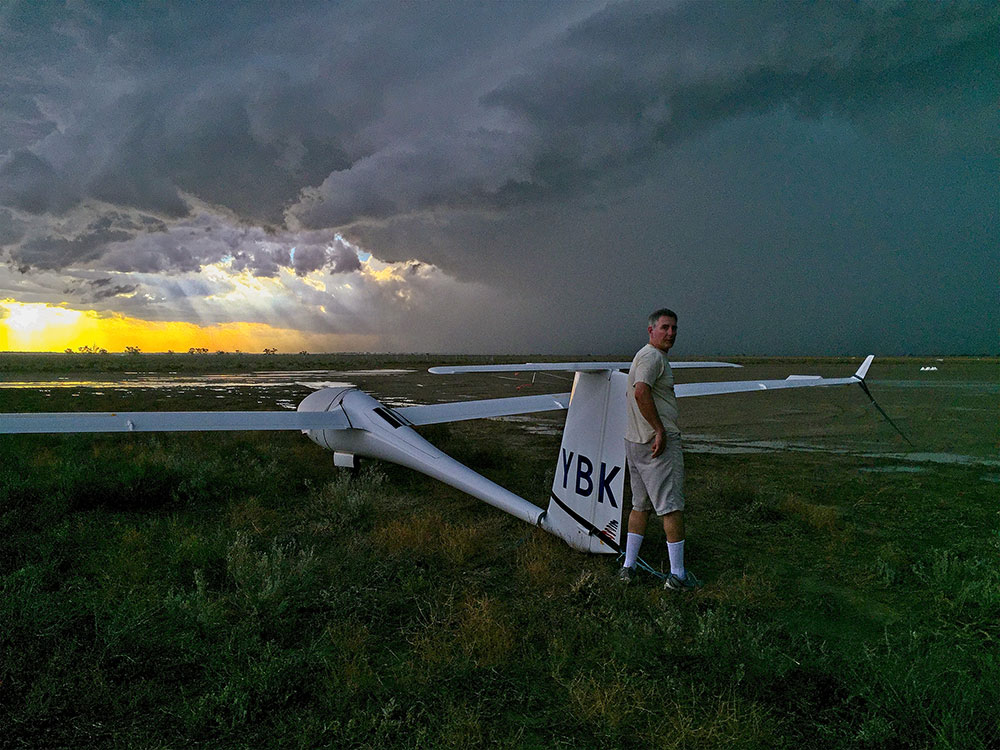
I was visiting Ian Downes at Tocumwal in the Ximango and went through another rushing mighty wind event. Thunderstorms can be great fun to fly near if you’re careful, but they can be really nasty on the ground. If your glider never leaves its hangar, then you’re probably wasting your time reading this. But if you fly away from your home strip and have to leave your glider out in the open for any reason, this article will hopefully be worth reading. No aircraft were damaged in the following events.
Big Wind
The first really big wind I saw on the ground was at Wentworth when flying through to Clare Valley in a safari. I’d launched first, to see if it was flyable. It was always difficult to get Geoff Sim in the air before afternoon tea time so I went up as wind dummy and, of course, there was lots of lift. So when I overflew Wentworth, I was 20 minutes ahead of the other three gliders. Geoff radioed me and asked what it looked like on track towards Clare. I replied, “I can’t see any problems.” That was mainly true but, in fact, it was so grey and gloomy up ahead that I couldn’t really see anything.
Geoff, who wasn’t steering on that day, was sitting in the back seat in typical Mr. Gloomy style, looking at the Origin Energy storm tracker website… which was all sparks. The decision was made to land at Wentworth but by the time I got there, all the good tie-down spots had been taken by the other gliders, leaving me with the sole option of tying down on the field.
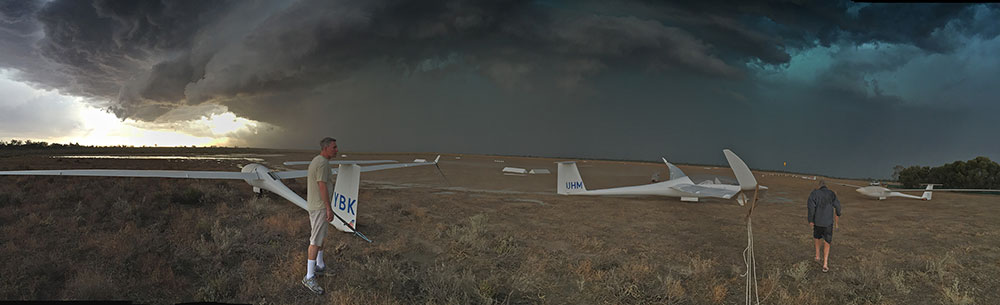
For some reason, they’d ploughed the entire Wentworth airfield that week. Instead of just a surface scratch, they had left behind a deeply ploughed gash, turning almost all of the strip into a fluffy crumble. The pair of two-seaters – the ASH25 of Ian Barraclough and Geoff Sim, and the Arcus of Harry and Wendy Medlicott – and Al Giles' ASH26 were tied down by a variety of means on a slight mound off to the side of the strip where the ground hadn’t been ploughed and was fairly solid. My DG-808 was tied down about 100m away near the boundary fence in the fluff.
Sudden Approach
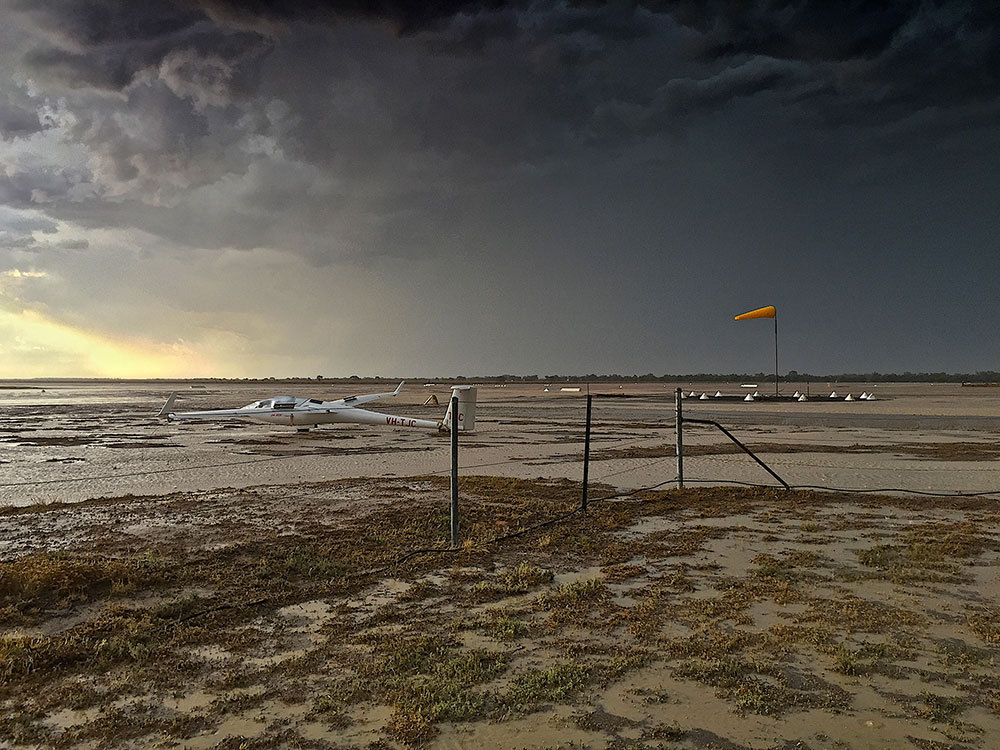
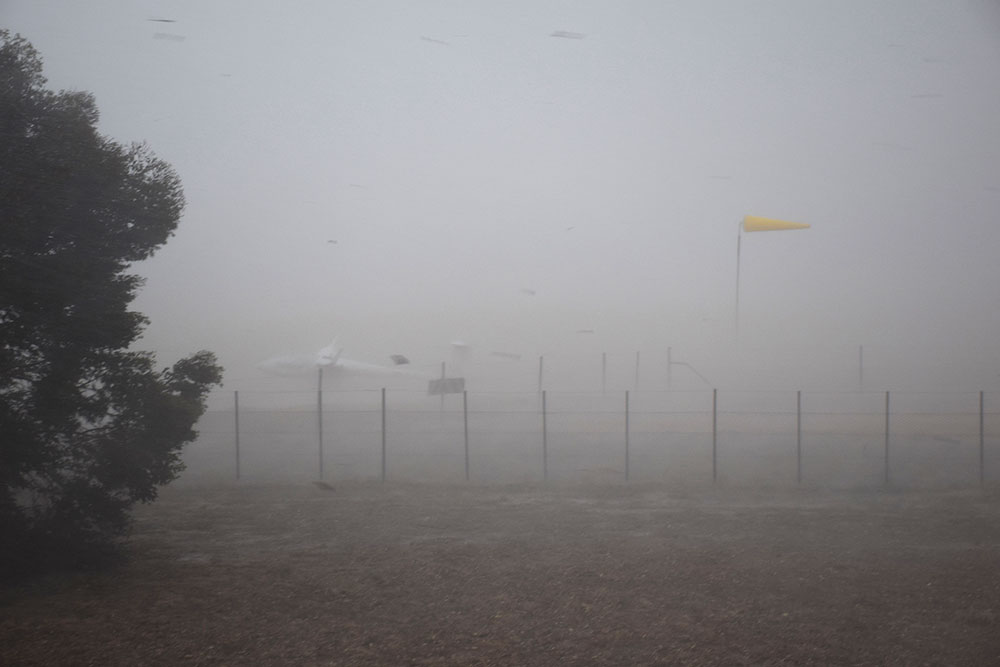
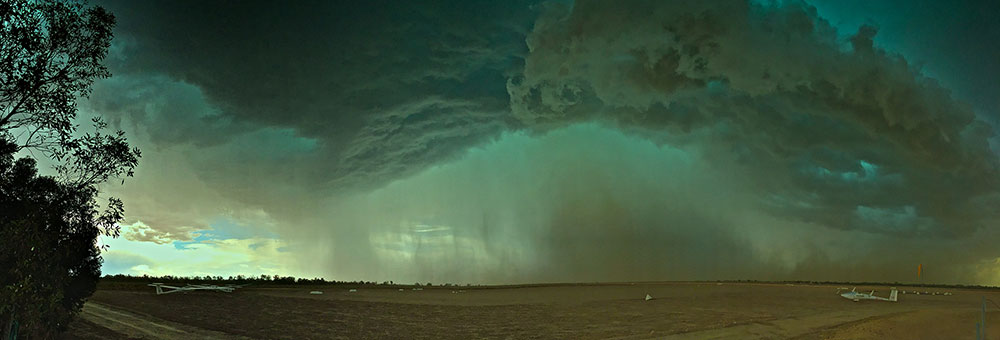
We watched the thunderstorm approach from the west with a local called Dale, who has a house and hangar close to the strip and took most of the pictures below. We then went off to the RSL for dinner. About an hour later, Dale called us and said we’d better get back to the strip. The storm was just crossing the field when we arrived. We parked the car but the wind and rain were so strong that it was almost impossible to breath. As the air was so full of flying dirt and debris, it was also almost impossible to see. We had to get back in the safari Tiguan and watch.
The DG is just visible on the left of the picture opposite. Other pictures show more flying debris – there was heaps of it. The windsock shows the minimum wind speed, depending on whether the windsock is the low wind or high wind design, something only windsock fans have time to check. Regardless, it was like standing in the blast of a jet engine.
I’ve been at sea in 55 knots of wind. It sucks the air out of your lungs and the rain hits so hard it stings. If you’re lucky enough to have long hair, it lashes your face and your eyes and most of what you do is done by feel. I guess the windspeed at Wentworth was in that region for five or ten minutes and there was little we could do. That evening, I got a real lesson on the power of a thunderstorm.
Blown Away
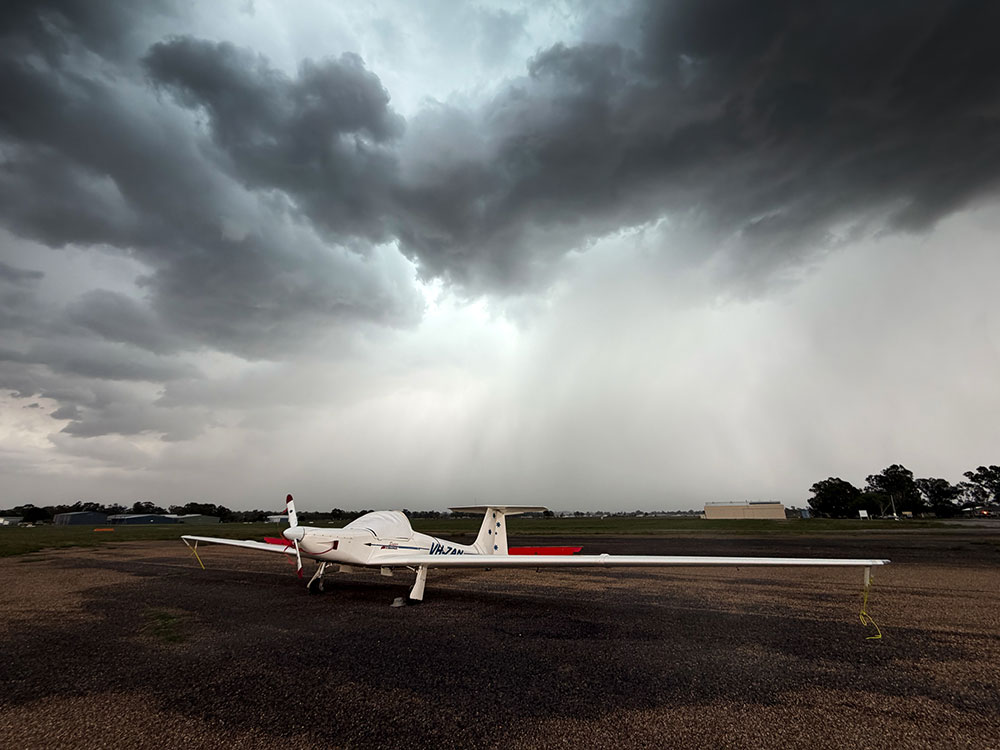
In another storm last week in Tocumwal, I was packing up the glider and doing the usual checks ready for an early departure the following morning. Somehow I didn’t notice the weather. It had been a nice sunny CU day some time earlier so I didn’t feel any cause for alarm. While sitting on the wing organising the baggage, the wind suddenly hit hard along with driving rain. The aircraft started to rock violently on its wheels and I was alarmed to see that one of the wing tip tie downs had blown off. I should have put the tie down ropes a lot further inwards on the cables.
The ailerons started flapping noisily and I struggled to hold the stick with one hand while trying to find a way of securing a rope to the stick with the other. In the end, the only solution I could find was to jam a bag between the stick and centre console to stop the movement. I opened the airbrakes and locked them with a seat belt and went to secure the wingtip. While I was there, the whole aircraft rolled forwards a few metres, so I ran back to put the brakes on. There wasn’t much more I could do. I estimate the wind strength to be at 40 - 45 knots, enough to fly the Ximango but not enough to blow it away.
So far as I know, there was no damage at either event, which was surprising. What follows are suggestions based on these experiences as well as lessons learned from a lot of safari flights, tying down on remote air fields.
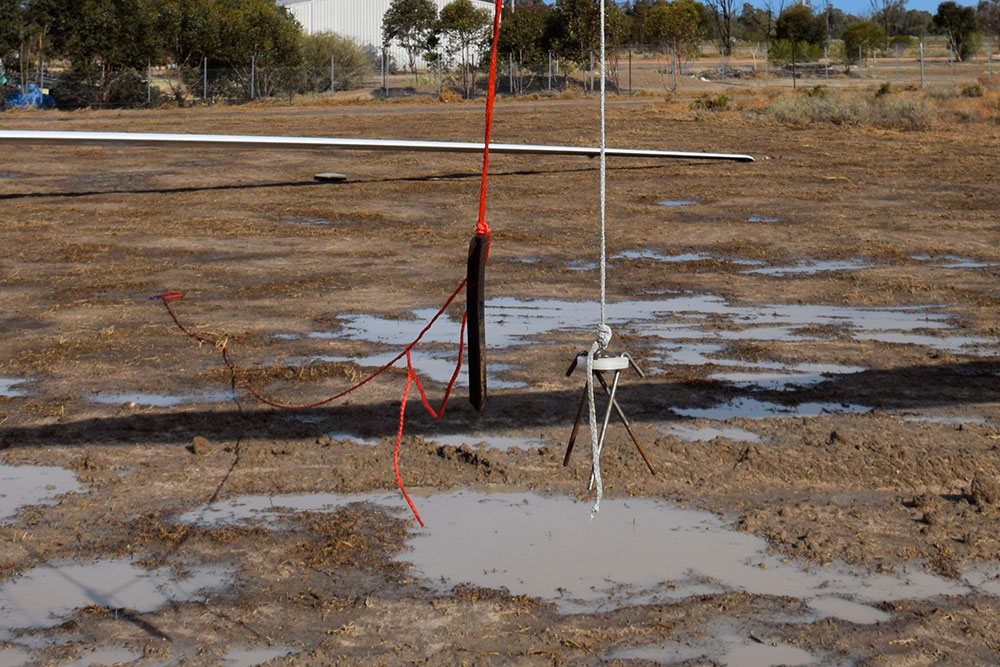
Oddly, the screw-its held but not the horizontal line pulling the individual screw-its inwards. Without this, the following day they pulled out with one hand but the glider was hull down in the mud, which secured it nicely.
Preparation
I think a lot of luck is involved in whether or not a glider tied down survives a big storm. I wouldn’t guarantee any of the methods mentioned below. You can see what works and what doesn’t, but that doesn’t mean that next time, the same method won't fail. The main thing is to be prepared. 50% of that preparation is the equipment you carry and the other 50% is making sure you recognise an incoming storm like Mr. Gloomy and do something about it.
If you’re airborne near thunderstorms, watch the shadows on the ground. If you think it’s better to land, do it early. The shadow of the spread out from thunderclouds can move incredibly fast and you may easily find yourself on the ground, unable to outrun a storm and with no time to properly secure the glider.
In the case of both of these Tocumwal storms, there was no way one could have stayed airborne and flown around them. They were just too big. I was on the ground during the storm at Mount Borah where the Czech paraglider pilotess set her world altitude record. One minute, three storm cells could be seen separated by tens of kilometres and the next, one giant storm was covering half the sky. While she survived, a Chinese pilot died a few hundred metres away.
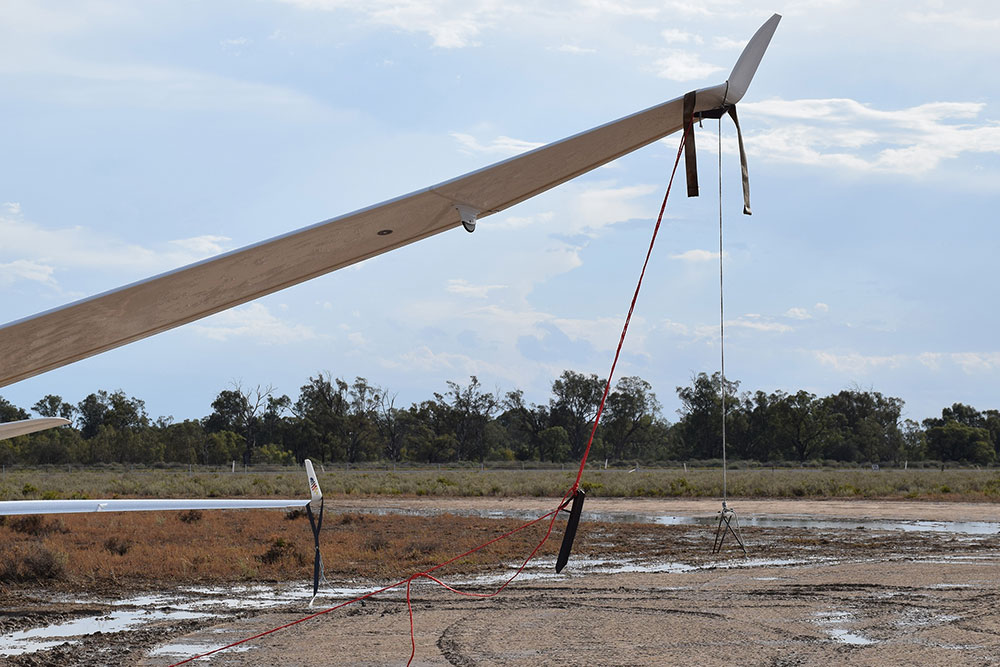
The stakes didn’t hold, nor did the disc with tent pegs. Judging by the slack rope on the tie down behind, something has moved there too, possibly the whole glider.
All Directions
In a thunderstorm, the wind will come from all directions, not just the one you expect, swinging 180º as the storm passes. So pointing gliders into the wind (as we happened to do at Wentworth) or against the wind (as at Tocumwal) won’t make much difference. There may be a lull followed by wind coming in from a different direction just as strongly a while later, as happened at Wentworth.
It’s my opinion that the best way to stop the glider flying is to get the airbrakes out. This isn’t normal practice with some types of gliders, where the manufacturer advises taping the airbrake covers shut to keep out the rain. DG only recommend draining the airbrake boxes after rain, so perhaps, hopefully, the bearings are sealed. Since my DG has a Piggott hook (which all self launchers should have) the airbrakes can easily be locked open.
Perhaps the biggest drawback to open airbrakes is that the drag of the glider increases. As a result, as in the case of the Ximango, it’s more likely to blow away, although a parked Ximango has plenty of cross sectional area. But in theory at least, open airbrakes spoil the lift and reduce the chance of a wing trying to fly.
Be careful about putting anything like a plastic bag on a probe. A strong wind will easily bend or break a probe if it’s got the added area of a plastic bag.
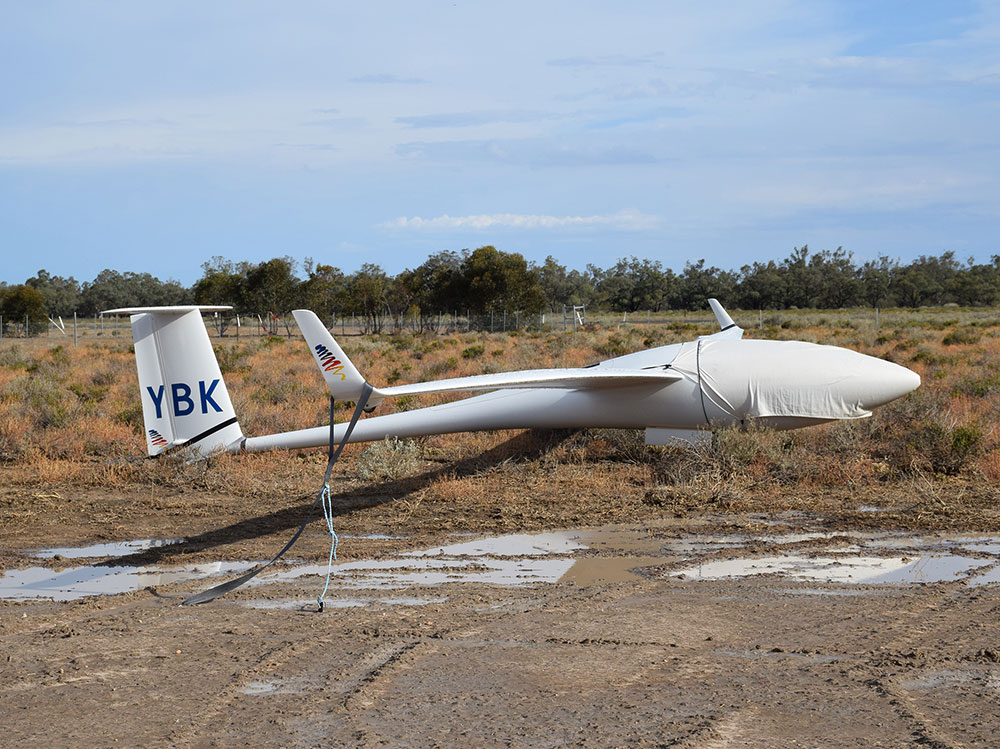
The tie downs have held but they’re loose, possibly because the glider moved. The strap around the tail is a good idea but should be longer to avoid the rudder being blown around.
Tie downs
A secure tie down setup is made up of three parts – what goes over a wing, what connects that to the ground and what the ground connection is. Ideally, your wingtip has a secure method of attaching a rope so you don’t need a strap of any sort. The only reliable rope in my opinion is Spectra, with low stretch and high strength. The best ground connection is ring or loop concreted into the bitumen, but you’re unlikely to have this option and anything else is suspect.
Solid tie down rings are nice if you are near them, but most gliders will take up two sets of tie downs. At a busy airport, that won’t make you popular if someone else arrives late.
On the face of it, cables seem like a good idea but in fact, they’re not very secure. Most are fairly loose and will allow a wing to lift or the aircraft to roll forwards so the angle of the tie downs on the wingtips changes. This can be a real problem if the tie downs get in the way of ailerons or flaps, which can get damaged.
Screw-its. I’m no big fan of screw-its since they’re impossible to use in most of Australia (the hard bit in the centre), and the last set I bought broke very quickly due to second-rate welding… Surprisingly, however, they held at Wentworth. The next day, in fact, when the ropes were removed, a single screw-it could be easily pulled out from the fluffy dirt.
The Screw-it instructions say that two screw-its should be used and a rope passed between the rings horizontally to pull the two together, and that held. I think this is interesting and might explain the fact that the Screw-its held. See the wingtips in the picture of the DG in the lake. This held better than the alternatives, and would almost certainly improve the performance with star picket type stakes.
Stakes. Several of the other gliders had either star-picket stakes or round plates with holes for pegs. These worked 60% in that on the two seaters, one wing pulled the stakes out of the ground. That’s a poor failure rate. Probably, two stakes cross-braced with a horizontal rope would work better. However you do need a mighty hammer in the glider to whack these things into the ground at many strips. As you’d expect, Al Giles carries a mighty hammer in the cockpit.
Rope. Don’t let rope become the weak point in a tie down setup. A 6mm Spectra (UHMWPE) rope will lift your whole glider… in its trailer. 8mm Spectra will lift the glider, the trailer and the tow car. Spectra doesn’t degrade like Bunnings and Aldi rope which can dissolve into a peculiar powder after a season in the sun. Don’t run rope over wings or winglets, especially thin cord like Spectra.
Seatbelt webbing is your man for going over wings and tail booms. You should have a few webbing loops in your tie down kit. You can always use them for lifting the tail boom or towing your glider off the strip without hurting your back.
The wingtip loops on the Ximango have a small additional strap to make sure they don’t move inwards and damage the ailerons. Either the Ximango moved or the cable moved (both did, in fact) or I didn’t secure the ropes to the cable well enough. Nevertheless, the rope went slack allowing the loop to blow off the wingtip. The ropes should angle well inboard and not be able to slip outwards.
Ideally, these loops should be properly sewn up with polyester yarn of suitable thickness… V132 or more. Most sailmakers have the webbing, sewing machine and thread though you can sometimes get a good walking foot industrial machine off Gumtree if the Authorities are not looking.
Wing fittings. Really, gliders should have proper fittings on the wing for tying down. Looping a strap over a winglet doesn’t really constitute a proper fitting. It’s a fairly simple matter to design wingtip wheels wise ie down hole. Aircraft with folding wings are probably safer with the wings unfolded and secured. Trying to fold wings in any wind is dangerous and unless secured, folded wings can easily flip over in a gale and possibly damage the hinge or the wing.
Wingtip Socks. Jim Staniforth sent a picture of some wingtip socks from the USA. I think these are promising. Like Jim, I have reservations – the webbing is too short and should spread the load better in the sock, the material might not be very good for UV stability and probably being more flexible would also help spread the load… if winglet fittings are actually strong enough.
Brave Sir Robin Ran Away
At some point during a big storm, there is nothing worthwhile you can do. Sitting in a glider cockpit that is suddenly upended is dangerous. I have no idea if a glider has even been flipped upside down with someone is sitting in it. But being trapped upside down in a glider cockpit somewhere in the bush isn’t great.
There’s little you can do if a wingtip really decides to lift… and you may be holding on to the wrong tip. My opinion is that you do everything you can to secure the glider before the storm hits and then at some point, you run away. Replacement gliders are available, while a replacement you is not.